Wednesday, 8 July 2015

To the Land of the Incas

My overall goal was to reach Cusco and Machu Picchu in Peru. From Rurre in Bolivia's part of the Amazon Basin, I decided to take the long way - overland to Cobija on the Brazilian border, then just a short distance (100 km) through Brazil to IƱapari in Peru. From nearby Puerto Maldonado it would be another long river trip, this time up the Rio Madre de Dios to Shintuya in the foothills of the Peruvian Andes. After Shintuya, the climb through the clouds to Cusco is short and dramatic. 

The bus ride to Cobija was a rather monotonous 26 hour endurance test through the Pampas. The monotony was punctuated when the bus was loaded onto a barge to cross the mighty Beni and Madre de Dios rivers which eventually flow into the Amazon. For most of the way I was sitting on my backpack in the aisle as the bus was packed. I would have preferred my bike at that point! I'll remember my brief 6 hour visit to Acre province of Brazil for the contrasts with Bolivia: the physically larger people, officials sharply dressed in uniform, sealed roads, modern buses, plainer food, large farms rather than smalll landholders, and of course the different language. There were similarities too: the jungle in the area has been well and truly tamed, removed of its mysteriousness, and the people I met were just as open and friendly as in Bolivia. 

In Peru, I found a boat to take me up the Rio Madre de Dios to the village of Boca Manu. Only reachable by boat, Boca Manu sits on the edge of the Parc Nacional Manu, a 20,000 sq km expanse of pristine jungle that is home to some of the world's last remaining uncontacted tribes. There was a festival going on and many inhabitants of the surrounding indigenous villages had made boat journeys of up to 3 days to be present. The festivities included music, dancing, competions in volleyball, football and archery, and of course drinking. I was able to stay in the house of a local family and enjoyed the relaxed and friendly atmosphere. 

The boat trip upstream from Boca Manu to Shintuya was pretty forgettable in an underpowered little pekapeka longboat that struggled against the increasingly swift current. The boat leaked, it rained all day and we ran out of fuel. It was a relief to finally arrive in Shintuya and have a soak in the nearby hotsprings!

From Shintuya, a dirt road climbs 3000 m up through the clouds to the city of Cusco on the Peruvian Altiplano. It was another rapid and dramatic change of scenery mirroring my descent friom Sorata and brought my time in the Amazon Basin to an end. The area around Cusco was the centre of power of the Incas and home to most of their most famous architectural wonders, including Machu Picchu. Once I get used to the cold again, I'm looking forward to getting out for some more exploring. 

The bus trip from Rurre to Cobija took around 26 hours on a dusty dirt road through the Pampas.

To cross the Rios Beni and Madre de Dios, the bus was loaded onto a barge. A tug was used to maneuver the barge.

A bus crossing in the opposite direction.

Plenty of action on the other side of the Rio Madre de Dios (still in Bolivia).

Unsurprisingly, fish is a pretty common meal in these parts. Cost: about US$ 2.


Much further on, I reached the village of Boca Manu. It is also on the Rio Madre de Dios, but much further upstream and now in Peru. A festival to mark the 35th anniversary of the region was on.

I met some journalists from the regional newspaper and accompanied them to the nearby indigenous village of Isla de los Bayas. They interviewed the chief of the village (in traditional clothes in front of me) and we all drank masato. Masato is made from fermented yuca (a root) and tastes pretty awful, especially after 4 bowlfuls.

Typical accommodation in the indigenous village.

Between the Boca Manu and Islas de los Bayas is a bridge straight out of Tomb Raider.

I spent 3 nights with a friendly family in Boca Manu. This was their house with attached comedor (dining area).

The archery contest. Men from the surrounding indigenous villages lined up to compete.

A cook-up of beef and yuca for the whole village. I helped peel the yuca, which is a type of root.

Idyllic sunset over the Rio Madre de Dios at Boca Manu.

Chilling while heading upstream from Boca Manu to Shintuya.

The joys of travelling upriver in a leaky boat in the rain and then running out of gas. The hardships were all forgotten when I reached Shintuya and soaked in the nearby hotsprings. The next day I reached the town of Salvacion by moto taxi.

Get out!, she said

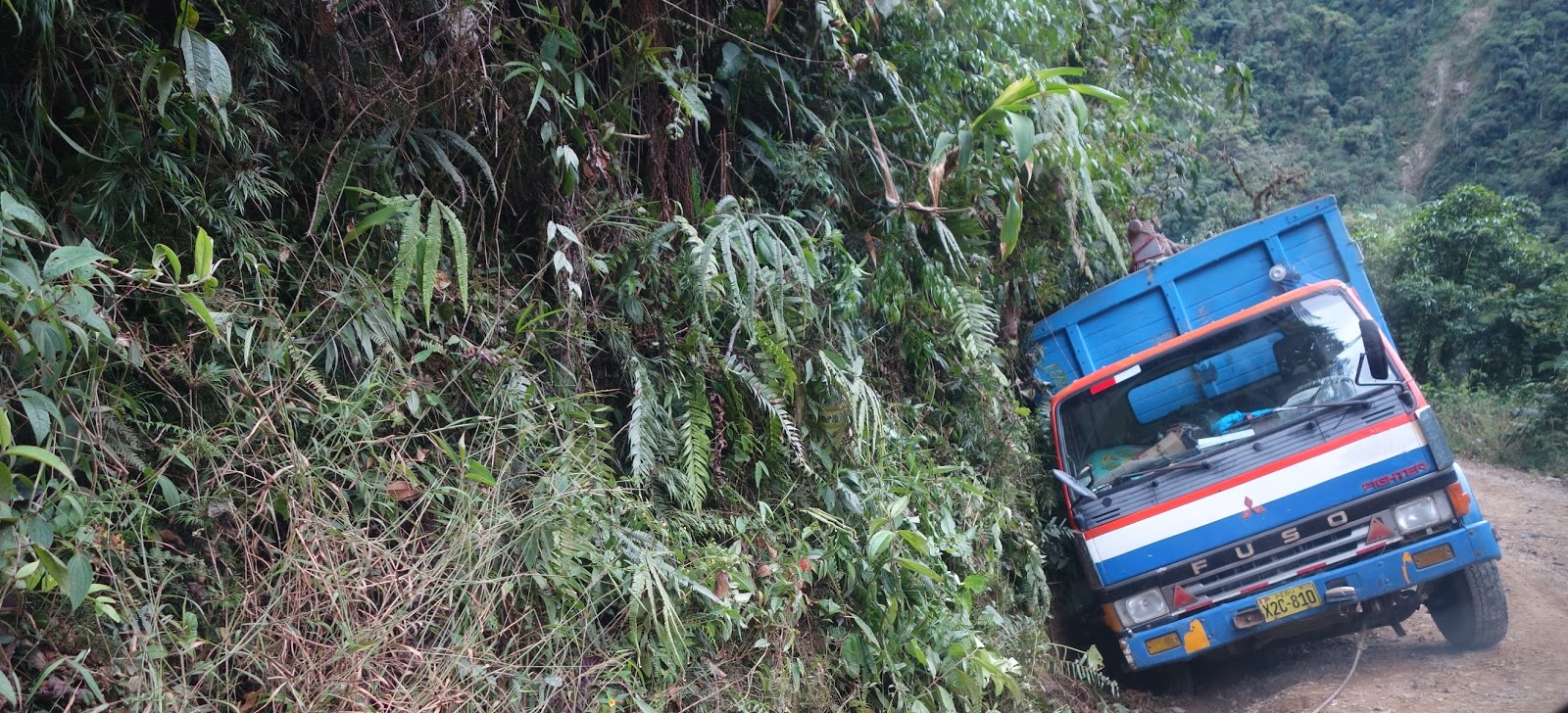
It's a rough road from Salvacion up and out of the jungle..

Finally I made it to Cusco!

Tuesday, 7 July 2015

Welcome to the Jungle

After weeks on the Altiplano, I was ready to leave the cold nights and dry air behind and descend into the hot and humid jungle of the Amazon Basin. Having just been at over 6000 m above sealevel on Huayna Potosi, within a few days and a few hundred kilometers I was just 300 m above sealevel. It was a remarkable change in vegetation, landscape and cultures over a short time and distance.

From La Paz, I headed to the village of Sorata that sits on the edge of the Altiplano in the shadow of 6368 m Illampu. From here I hiked the precipitous dirt road down to the jungle, picking up rides as and when they came along. I was soon in the clouds and with the humidity the vegetation increased. As I descended, following the Mapiri river, I passed many goldmining operations on the steep and deforested slip-prone hillsides. The ramshackle town of Santa Rosa with its row of empty nightclubs waiting for lucky goldminers to walk in was the hub of activity in the region. Further on I reached Guanay, now well and truly in the jungle, and found a boat to take me down the Rios Kaka and Beni to Rurrenabaque. The trip took 3 days with two nights of camping on the riverbank. As I floated through the lush green jungle with its bugs, humidity, technicolour sunsets and nocturnal cacophony of animal sounds, the stark, cold beauty of the Altiplano seemed a distant memory. 

In Rurre I was back on the Gringo Trail and celebrated my birthday with a 3 day tour to the Pampas, where I swam with river dolphins, fished piranhas and spotted caymans, turtles, monkeys, capybaras, a sloth and lots of birds. It was a lot of fun. Swimming in murky water with caimans and piranhas and then having a curious dolphin brush my leg and nibble my big toe was something I won't forget quickly. 

On the way to Sorata...not the most flattering portrait of this local offical.

Sorata sits in the shadow of 6368 m Illampu.


It could also be on the French or Italian Riviera.

The way ahead. I travelled by bus as far as Tacacoma.

Tacacoma was shrouded in mist in the mid afternoon.


After spending the night in Tacacoma, I hiked down into the clouds...


...and it was a long way down.

Lower down, everything was wetter, greener.

I made good progress thanks to rides from locals. I had a spot in the back.

There were many gold mines along the way, including this one near Santa Rosa.


Finally at Guanay I could continue my journey by boat on the Rio Kaka.


Ruben, el Capitan.


Ruben's boat. Early morning mist was the norm.


A Chinese-run goldmining dredge.


Cacao is grown by the indigenous people living near the river bank. The pulp is quite tasty and sweet, while the beans are used to make chocolate.


Drying the beans.

A butterfly enjoying some papaya seeds.

A capybara on the riverbank. Wildlife was not that prevalent, as the animals have to compete with humans living in the area.

Leaving the mist behind and approaching Rurrenabaque.


Boats lined up on the riverbank at Rurrenabaque. From here I took a tour to the Pampas, where wildlife can be more easily spotted.

Hoping no caimans were lurking, we jumped in the river and waited for the river dolphins. They didn't take long to arrive.

Squirrel monkeys.


A caiman, which is a type of alligator specific to South and Central America. This one was about 3 m long.

The turtle and the butterfly.


We went fishing for piranhas and managed to catch about 10. They are pretty tasty fried up with a bit of lime juice.


Our hunt for an anaconda in the swamp was not so successful...


We were lucky to spot a 3 toed sloth making his way down a tree trunk.


There was a huge amount of birdlife in the Pampas.


Madrugada.


What lurks beneath...


Monday, 22 June 2015

Last Days on the Bolivian Altiplano

After two and a bit weeks of Spanish lessons in Sucre, I hit the road again - without my bike this time. I had several goals - re-visit Potosi, visit La Paz and Lake Titicaca, climb a 6000 m mountain,  and drop off the altiplano into the jungle...

Sugar cane and oranges in abundance at the Mercado Campesino on the outskirts of Sucre.

A blind busker in the Mercado Campesino, Sucre.

Cerro Rico, the mountain of silver (and tin) that made Potosi so important.

An ornate building facade in Potosi befitting of what was once the wealthiest city in the world.

A view of La Paz from El Alto, with Illimani (6438m) in the background.

Thieves beware in El Alto!

A church on the Yampupata peninsular north of Copacabana, on the way to Lake Titicaca.

Late afternoon on the Yampupata peninsular, near the village of Sicuani. I slept the night here and caught a ride to Isla del Sol with a fisherman the next morning.


Terraced hillsides dating from the Incas on Isla del Sol in Lake Titicaca, almost 4000 m above sealevel!

The Incan ruins of Chincana at the north end of Isla del Sol.

I had the ecolodge and the magical sunset at the north end of Isla del Sol all to myself.

The Cordillera Real in the background - my next destination.

Huayna Potosi, at 6088 m, is regarded as one of the easiest 6000 m peaks in the Andes. I decided to give it a crack.

Day 1: Hiking to the intermediate hut at 5130 m.

The view from the hut with the glacier to the right.

Before sunset, there was a little bit of time for me to get used to my supersized mountaineering boots. The boot on my left foot is size 46...

Day 2: We set off at 1 am in the morning. Five hours later, the sun was coming up as we approached the summit. Seems I was too nervous to hold the camera straight.

Sunrise over some other peaks in the Cordillera Real.

The view towards Illimani. Lake Titicaca to the right.

 Me and my hiking buddies on the summit. To my right is Sam, then Kai and our two local guides.

Back at the intermediate hut and feeling pretty happy with ourselves.